
Commercial Washers & Dryers for Florida Laundry Facilities
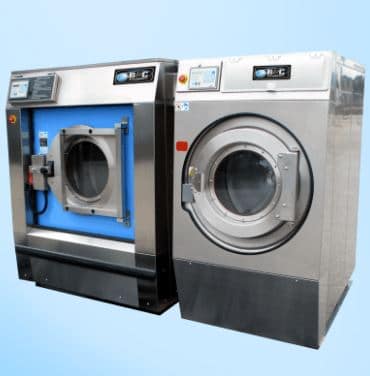
Commercial washers and dryers are central to the production flow of hotels, healthcare facilities, linen services, laundromats, dry cleaners, assisted living facilities, industrial laundries, and other operations that process textiles every day.
The right equipment has to do more than handle a stated load capacity. It needs to fit the facility’s workflow, utilities, production schedule, floor space, textile mix, and the equipment operating before and after it.
Gulf Coast Equipment Sales provides commercial and industrial laundry equipment for Florida businesses, with B&C Technologies as a primary equipment brand for washers, dryers, and related laundry systems.
For facilities replacing older equipment, opening a new laundry, or expanding an existing operation, washers and dryers should be evaluated as parts of a connected production system rather than isolated machines.
Commercial Washers and Dryers Work as a Production System
A washer and dryer may be purchased separately, but on the laundry floor they operate as connected stages of the same process.
Washers determine how goods enter the production flow, while extraction affects how much moisture remains when those goods move to drying. Dryers then need to process those loads at a pace that fits the rest of the operation.
After drying, linens, uniforms, garments, towels, or other textiles may move to finishing, ironing, folding, packaging, or storage. Those downstream stages also affect how well the laundry performs as a whole.
This is why the largest available machine is not automatically the best choice. Equipment should be balanced around the facility’s actual workload and process flow.
A consistent mismatch between major production stages can create delays even when each individual machine is operating normally.
Gulf Coast Equipment Sales’ B&C industrial and commercial laundry equipment page includes B&C washer, dryer, and flatwork-equipment categories available for Florida operations.
The broader goal is to create a production line in which washing, drying, finishing, and material handling support one another.
B&C Technologies Commercial and Industrial Washers
B&C Technologies manufactures washer-extractors for a range of commercial and industrial laundry applications.
Gulf Coast Equipment Sales currently lists B&C HE, HP, SP, SI, SA, and SB washer families. These equipment lines give facilities options when evaluating different production environments and laundry requirements.
Washer selection should consider the goods being processed, typical load characteristics, extraction needs, available utilities, installation conditions, and how the washer will connect to the rest of the workflow.
Extraction is particularly important because the amount of moisture remaining in a load affects what happens during drying. A washer should therefore be evaluated not only by its stated capacity but also by how it supports the next production stage.
Facilities may also process very different textiles. Hospitality linens, healthcare textiles, uniforms, garments, mats, towels, and specialty items can have different process requirements.
B&C equipment is used in commercial laundry, industrial laundry, hospitality, healthcare, dry-cleaning, and wet-cleaning environments. The appropriate washer should be matched to the facility’s actual application rather than selected simply because another operation uses the same machine.
Detailed capacity planning based on daily production volume belongs to a more specific equipment-selection review. At the authority-page level, the main consideration is whether the washer fits the overall production system.
B&C Technologies Commercial and Industrial Dryers
Drying is another critical stage of commercial laundry production.
Gulf Coast Equipment Sales lists B&C DE Series commercial dryers, DP and DI Series industrial dryers, along with specialized drying equipment for applications that may not use conventional tumble drying.
Dryer selection depends on the textiles being processed, washer output, extraction conditions, available utilities, ventilation, makeup air, exhaust requirements, floor space, and the broader production workflow.
Dryers should be matched to the wash side of the operation so one stage does not consistently overwhelm the other.
Ventilation and makeup air are especially important during installation. Commercial dryers move significant amounts of air, so room conditions, exhaust routing, service clearances, and utility connections need to be reviewed before equipment placement is finalized.
Some operations also process garments or specialty items that require alternative drying methods. In those cases, drying-cabinet equipment may be appropriate.
Facilities comparing the full range of garment-care and textile-processing equipment can also review Gulf Coast Equipment Sales’ dry cleaning equipment and machines page.
The right dryer is therefore determined by the goods, production flow, utilities, and facility conditions rather than capacity alone.
Plan Utilities and Floor Space Before Equipment Arrives
Commercial washers and dryers depend on the infrastructure around them.
Washer installations may involve water supply, hot-water capacity, drainage, electrical service, chemical systems, floor loading, and adequate room for loading and unloading.
Dryer installations can involve electrical or gas service, exhaust ducting, makeup air, service clearances, and sufficient room for safe operation and maintenance access.
These requirements should be reviewed before equipment is ordered.
A machine that physically fits within a floor plan may still be a poor fit if the facility cannot support its utility or installation requirements.
Existing laundries should also avoid assuming that connections used by older equipment will automatically suit replacement machines.
Layout affects material handling as well. Operators should consider how carts and goods move between washers, dryers, finishing equipment, folding areas, and storage.
Facilities with steam-supported finishing equipment should also consider how laundry production connects to the boiler room. Gulf Coast Equipment Sales’ commercial laundry boilers and steam systems page covers boiler, feedwater, condensate return, blowdown, and related steam infrastructure for commercial laundry operations.
Equipment planning works best when utilities, floor layout, production flow, service access, and supporting infrastructure are reviewed together.
Match Equipment to the Goods Being Processed
Not every commercial laundry handles the same textiles.
Hotels and resorts may process sheets, towels, pillowcases, table linens, and uniforms. Healthcare and assisted-living operations may have different textile handling needs. Dry cleaners and wet-cleaning operations may process garments requiring different wash and drying programs. Industrial laundries may handle uniforms, mats, workwear, or other demanding loads.
The equipment should support those actual goods.
Washer programmability, extraction, load characteristics, and process controls may matter when a facility handles several textile categories. On the drying side, airflow, temperature control, load type, and the suitability of tumble drying can influence equipment choice.
B&C Technologies offers equipment for multiple commercial and industrial markets, allowing facilities to evaluate machines according to the work being performed.
The next production stage should also be considered. If the laundry processes substantial flatwork, washers and dryers may feed ironers, feeders, folders, or other finishing equipment. Garment operations may move goods to pressing or other finishing stations.
Facilities evaluating downstream finishing can also review Gulf Coast Equipment Sales’ laundry presses for additional equipment used after washing and drying.
Selecting equipment around textile type and workflow creates a more coherent laundry process.
Parts, Service, and Long-Term Equipment Support Matter
Commercial laundry equipment operates in an ongoing production environment, which makes parts availability and serviceability relevant when evaluating washers and dryers.
Gulf Coast Equipment Sales provides equipment sales, parts, and service support for commercial and industrial customers in Florida. Its B&C equipment page includes washer and dryer equipment along with B&C parts and service information.
Facilities should consider whether technicians can reach major service points, whether model information is easy to identify, and whether replacement parts can be matched correctly to the equipment.
Service access begins with installation. Washers and dryers should not be positioned so tightly against walls or nearby equipment that routine inspection or repair becomes unnecessarily difficult.
Operators should also retain equipment documentation, serial information, and model records so future parts and service requests can be handled accurately.
For facilities already using B&C Technologies equipment, maintaining those records can simplify future support.
Gulf Coast Equipment Sales can assist Florida businesses with equipment additions, replacements, parts, and service through its contact department.
Build the Laundry Around Balanced Production
The strongest commercial laundry equipment plan is based on the complete workflow rather than one machine.
Washer capacity, extraction, dryer capacity, utilities, textile type, finishing equipment, staffing, material movement, and operating schedule all influence how the laundry performs.
Adding one machine may improve a specific stage without changing overall throughput if another part of the workflow remains the limiting factor.
For that reason, commercial washers and dryers should be evaluated together with the surrounding laundry system.
Gulf Coast Equipment Sales works with Florida commercial and industrial operations evaluating B&C Technologies washers, dryers, flatwork equipment, and related laundry systems.
Facilities may include hotels, resorts, healthcare operations, assisted living facilities, laundromats, dry cleaners, linen services, industrial laundries, and other organizations with ongoing textile-processing requirements.
A useful starting point is to document the goods being processed, current workflow, available utilities, equipment space, and the areas where production is being limited.
That information creates a stronger basis for comparing commercial washers and dryers without assuming that the largest machine or highest stated capacity is automatically the right choice.
To discuss B&C Technologies washers, dryers, parts, service, or a broader laundry-equipment project in Florida, contact Gulf Coast Equipment Sales.
Frequently Asked Questions
What is the difference between commercial and industrial laundry equipment?
The terms can overlap, but industrial laundry equipment generally refers to machines used for heavier production demands or larger-scale processing. Equipment should be selected according to workload, textile type, production schedule, utilities, and facility requirements rather than terminology alone.
How should commercial washers and dryers be matched?
Washers and dryers should be evaluated according to load characteristics, washer output, extraction, drying requirements, production schedule, and downstream finishing capacity. The objective is to keep major production stages reasonably balanced.
What should a facility check before installing a commercial dryer?
Facilities should review the dryer’s utility requirements, exhaust, makeup air, service clearances, floor space, and connection requirements before installation. Manufacturer documentation and applicable installation requirements should guide the final setup.
Does Gulf Coast Equipment Sales carry B&C Technologies washers and dryers?
Yes. Gulf Coast Equipment Sales offers B&C Technologies commercial and industrial laundry equipment in Florida, including multiple washer and dryer series and related laundry equipment.
Does Gulf Coast Equipment Sales provide parts and service for B&C equipment?
Yes. Gulf Coast Equipment Sales provides parts and service support for B&C Technologies equipment and other commercial and industrial laundry equipment used by its Florida customers.